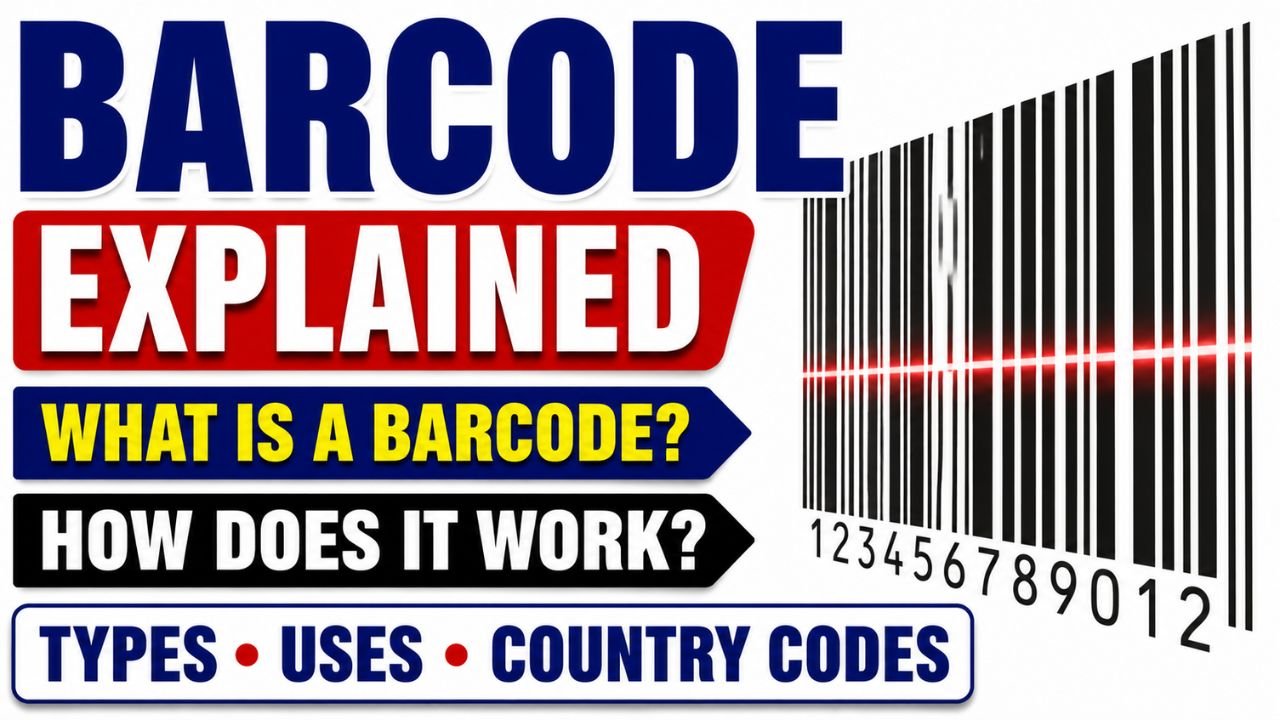
Barcodes are now a common part of our daily life. We see them on soap, oil, cream, food packets, medicines, mobile products and many other household items.
Barcodes are now a common part of our daily life. We see them on soap, oil, cream, food packets, medicines, mobile products and many other household items. These black lines may look simple, but they contain useful information about a product. In this article, we will understand what a barcode is, how it works, how a barcode scanner reads it, and what information it can provide. We will also learn about 1D and 2D barcodes, the difference between them, and the basic structure of a traditional 1D barcode.
We will also look at how companies and stores use barcodes to manage their products. A barcode can help identify a product, track stock and make billing easier. Different products can have different barcode numbers. These codes are created and managed through international barcode standards. We will also understand how the black and white lines are converted into digital information that a computer system can understand.
By the end of this article, you will have a basic understanding of barcode technology. You will learn why barcodes are important, how scanners read them, what 1D and 2D barcodes mean, and how product identification works. So, let us understand the technology behind the simple black lines that we see on products every day.
What Is a Barcode?
A barcode is a method of storing product information in a form that can be read by a machine. It is usually made using black lines and white spaces. These lines and spaces are arranged in a specific pattern. A barcode scanner reads this pattern and converts it into information that can be processed by a computer system.
The information connected with a barcode can include details related to a product. Depending on the barcode system and database, it may be used to identify the product, its manufacturer, product number, price information and other details. The barcode itself does not always contain every piece of product information directly. Instead, the barcode number can be connected to product information stored in a computer database.
Barcodes are especially useful in shops, supermarkets, warehouses and manufacturing companies. When a product is scanned, the system can identify it quickly. This makes billing faster and reduces the need to enter product information manually. Companies can also use barcode systems to track products and manage their inventory.
How Did Barcode Technology Become Important?
Barcode technology became important because businesses needed a faster and more reliable way to identify products. Earlier, many product details had to be entered manually. This process could take time and could also lead to mistakes. Barcode technology helped solve this problem by allowing machines to read product identification information quickly.
Today, barcodes are used in many areas. They can be found on household products, food items, medicines, electronic products and packages. They are also used in warehouses and logistics systems. Whenever a product moves from one location to another, barcode scanning can help track its movement through the supply chain.
The main benefit of barcode technology is speed and accuracy. A worker can scan a product within seconds. The computer can then identify the product and update the required information. This is one reason why barcode technology has become an important part of modern retail and product management.
What Information Can a Barcode Provide?
A barcode is mainly used to identify a product. When the barcode is scanned, the system can connect the barcode number with information stored in a database. This may include the product name, manufacturer details, product category and other information. In a store, the system can also show the selling price linked to that particular product.
Barcode systems are also useful for tracking the quantity of products. For example, when a product is sold, the store's inventory system can update the stock quantity. This allows the store to know how many units are available. It can also help the store identify products that need to be reordered.
It is important to understand that the barcode itself does not necessarily store all product details. In many systems, it acts as a unique identification number. The scanner reads the code and sends the information to a computer system. The computer then searches its database and displays the relevant product information.
Who Assigns Barcode Numbers?
Barcode numbers are generally created and managed according to international standards. One of the major organizations involved in global barcode standards is GS1. It provides systems that help businesses identify products and manage product information across different markets.
A product or product package can be assigned a unique identification number according to the relevant barcode standard. This helps businesses and retailers identify products correctly. The same identification system can be used across different stages of the supply chain.
The use of international standards is important because products are sold across different regions and countries. A common system makes it easier for manufacturers, distributors, retailers and other businesses to work with product information. This standardization is one of the major reasons barcode technology is widely used around the world.
Main Types of Barcodes
Barcodes can be broadly divided into two major categories. These are 1D barcodes and 2D barcodes. The two types are different in their design and the amount of information they can represent.
A 1D barcode is usually made using vertical black lines and white spaces. It stores information along one direction. Traditional product barcodes found on items such as soap, packaged goods and many retail products are common examples of 1D barcode technology.
A 2D barcode uses a two-dimensional pattern. QR codes are one of the best-known examples. They can store more information than many traditional 1D barcodes. QR codes are now used for payments, websites, digital menus, tickets, product information and many other applications.
What Is a 1D Barcode?
A 1D barcode is also known as a one-dimensional barcode. It generally consists of a series of black bars and white spaces. The width and arrangement of these bars and spaces represent coded information.
1D barcodes are commonly used for product identification. They can be seen on products in supermarkets, shops and other retail stores. When the barcode is scanned, the scanner reads the pattern and sends the information to a computer or billing system.
The amount of information represented directly by a 1D barcode is limited compared with a 2D barcode. However, 1D barcodes are simple, fast and reliable for product identification. This is why they continue to be widely used in retail and inventory systems.
What Is a 2D Barcode?
A 2D barcode is a two-dimensional barcode. A QR code is a popular example of this type of barcode. Unlike a traditional 1D barcode, a 2D barcode can represent information in both horizontal and vertical directions.
Because of this structure, 2D barcodes can store much more information than traditional 1D barcodes. They can be used to store or provide access to website links, text, contact information and other digital data. QR codes are also commonly used in digital payment systems and mobile applications.
Another important advantage of many 2D barcode systems is their ability to remain readable even when part of the code is damaged. Depending on the specific barcode standard and error-correction level, a scanner may still be able to read the code. This makes 2D barcodes useful for many modern applications.
Difference Between 1D and 2D Barcodes
The main difference between 1D and 2D barcodes is how information is represented. A 1D barcode uses a series of lines and spaces. Information is mainly represented along one direction. A 2D barcode uses a pattern that contains information in two directions.
Another difference is data capacity. A 2D barcode can generally hold much more data than a traditional 1D barcode. This makes 2D barcodes useful for applications where more information needs to be stored or accessed.
1D barcodes are still widely used for product identification and retail billing. 2D barcodes are becoming increasingly popular for digital applications. QR codes, for example, are commonly used with smartphones and payment services. Both technologies have their own advantages and are selected according to the requirements of a particular system.
How Does a Barcode Scanner Work?
A barcode scanner uses light to read the pattern of black bars and white spaces. When the scanner is moved over the barcode, light is directed toward the code. The scanner detects how the light is reflected from the different areas of the barcode.
Black bars absorb more light, while white spaces reflect more light. The scanner detects these differences and converts them into an electrical signal. The signal is then processed by the scanner and converted into digital information.
The computer system receives the decoded information and uses it to identify the product. In a retail shop, this can automatically bring up the product information on the billing screen. This process happens very quickly, which makes barcode scanning useful for fast billing and inventory management.
How Does a Computer Understand a Barcode?
Computers work with digital information. At the basic level, digital systems represent information using binary values, commonly described as 0 and 1. A barcode scanner converts the pattern it sees into digital data that a computer system can process.
The black and white pattern is not simply read as ordinary text. The scanner uses the barcode's specific encoding rules to understand the arrangement of bars and spaces. Different barcode standards have different structures and rules for representing numbers and other information.
The scanner then sends the decoded result to the computer. The computer uses that result to identify the product or information connected to the code. In this way, a simple pattern of black lines becomes useful digital information for stores, companies and customers.
Understanding the Structure of a Traditional Barcode
A traditional 1D barcode is divided into different sections. These sections help the scanner understand where the barcode starts, where the data is located and where the barcode ends. Special guard patterns can be used to separate different parts of the barcode.
For example, in the commonly used EAN-13 barcode format, the barcode represents 13 digits. The structure includes start, middle and end guard patterns. The data digits are represented using specific combinations of bars and spaces.
The left and right parts of the barcode use different encoding patterns. These patterns help the scanner understand the direction and structure of the barcode. This is why a barcode scanner can correctly identify the numbers represented by the black and white lines.
How Are Numbers Represented in a Barcode?
In many traditional barcode systems, each number is represented using a particular combination of black bars and white spaces. The scanner does not directly see the number printed below the barcode. Instead, it reads the pattern and then converts that pattern into a number.
In an EAN-style barcode, the left and right sides use different encoding patterns. The patterns help the scanner identify the position of the digits. The guard patterns also help the scanner understand the beginning, middle and end of the code.
The numbers printed below a barcode are mainly provided for human reference. The scanner normally reads the bars and spaces. It then uses the barcode standard to decode the pattern and obtain the corresponding numeric information.
What Are Barcode Guard Patterns?
Guard patterns are special patterns used in some barcode formats. They help the scanner identify important sections of the barcode. In an EAN-13 barcode, there are start, middle and end guard patterns.
These guard patterns make it easier for the scanner to understand the structure of the code. The scanner can identify where the barcode begins and where the central division occurs. This helps it correctly interpret the information on both sides.
The guard patterns are an important part of barcode design. Without proper structure, a scanner would have difficulty understanding where one section starts and another section ends. Barcode standards define these patterns so that compatible scanners can read the code correctly.
What Do the First Digits of a Barcode Mean?
There is often confusion about the first digits of a barcode. In many cases, people believe that the first digits directly tell the exact country where a product was manufactured. This is not always correct.
For example, GS1 prefix ranges can indicate the GS1 organization or region that allocated the barcode number. They do not necessarily prove the actual country where the product was manufactured. A company may receive a barcode prefix through a particular GS1 organization and manufacture its product in another country.
Therefore, barcode prefixes should not be treated as a guaranteed proof of the manufacturing country. To know where a product was actually made, consumers should check the product packaging for information such as "Made in India", "Made in USA", or another country-of-origin statement.
Examples of GS1 Prefix Ranges
Different countries and regions have different GS1 prefix ranges. For example, India is associated with GS1 prefixes in the 890 range. The United States and Canada commonly use prefixes from 000 to 139. France is associated with ranges including 300–379, while Germany is associated with 400–440.
Russia has ranges including 460–469, while Australia uses 930–939. These numbers are examples of GS1 prefix ranges used for barcode number allocation. They should not be confused with a direct guarantee of where the product was manufactured.
For accurate information, it is always better to check the official product packaging and the manufacturer's details. A barcode can help identify the company or product number, but the actual manufacturing location may be different from the organization that assigned the barcode.
How Do Shops Use Barcodes?
Retail stores use barcodes mainly for billing and inventory management. When a customer buys a product, the cashier scans the barcode. The billing system identifies the product and displays the information connected with it.
The store can then calculate the bill quickly. This reduces the need to manually enter product details. It also reduces the chances of human error during billing. The process is especially useful in supermarkets where hundreds or thousands of products may be sold every day.
Barcodes also help stores maintain inventory records. When a product is sold, the stock quantity can be updated automatically. Store managers can then check which products are available and which products need to be ordered again.
How Do Companies Use Barcode Technology?
Manufacturing companies use barcodes to identify products during production, packaging and distribution. A barcode can help businesses track products as they move through different stages of the supply chain.
Warehouses also use barcode scanning to manage incoming and outgoing products. Workers can scan items when they arrive and again when they are shipped. This helps businesses maintain better records of their stock.
Barcode systems can save time and improve accuracy. They also make it easier to locate products in large warehouses. As businesses become more dependent on digital inventory systems, barcode technology continues to play an important role.
Can a Barcode Tell the Price of a Product?
A common question is whether scanning a barcode directly reveals the price. The answer depends on the system being used. In many retail systems, the barcode mainly identifies the product. The billing computer then looks up the current price in its database.
This means that the same product barcode can be connected to different prices in different stores. The store's own database determines the price displayed during billing.
Therefore, a barcode should not always be considered a direct storage place for the product price. Instead, it often works as a key that allows the computer system to find the product's details, including the current price.
Can We Find a Product's Country by Scanning Its Barcode?
Barcode scanning can help identify a product and provide information connected to its barcode number. However, it is not always possible to determine the exact manufacturing country simply by looking at the first digits.
GS1 prefixes generally show where the barcode number was allocated or which GS1 organization issued the number. The company may manufacture the product in another country.
Therefore, if you want to know the actual country of manufacture, you should check the product packaging. Look for the country-of-origin information printed by the manufacturer. This is more reliable than assuming the manufacturing country from the barcode prefix alone.
Important Points About Barcodes
- A barcode is a machine-readable way to represent product identification information.
- Traditional 1D barcodes use black bars and white spaces.
- 2D barcodes can store more information than many 1D barcodes.
- QR codes are a common example of 2D barcodes.
- Barcode scanners use light to read the pattern.
- Black and white areas reflect light differently.
- The scanner converts the pattern into digital information.
- Retail stores use barcodes for billing and inventory management.
- Companies use barcodes to track products and stock.
- Barcode numbers follow international standards.
- GS1 is a major organization involved in global identification standards.
- Barcode prefixes do not always prove the actual manufacturing country.
- The product packaging should be checked for accurate country-of-origin information.
- 1D barcodes are commonly used for product identification.
- 2D barcodes are widely used for digital information and QR-based applications.
- A barcode usually identifies a product, while detailed information may be stored in a connected database.
Advantages of Barcode Technology
One of the biggest advantages of barcode technology is speed. A scanner can read a barcode in a very short time. This makes billing and product identification much faster than manual data entry.
Another important advantage is accuracy. When product information is entered manually, there is always a possibility of typing errors. Barcode scanning reduces this problem because the scanner reads the coded pattern directly.
Barcode technology is also useful for inventory control. Businesses can track products, update stock records and manage warehouses more efficiently. These benefits make barcodes an important technology in retail, manufacturing, logistics and supply chain management.
Barcode Technology in Everyday Life
Most people use barcode technology without even realizing it. When we purchase a product from a supermarket, the barcode is scanned at the billing counter. The same technology may also be used behind the scenes to manage the store's inventory.
Barcodes are also found on packages, shipping labels and warehouse products. They help businesses track goods as they move from manufacturers to distributors and finally to retailers.
With the growth of smartphones and digital payments, 2D barcodes and QR codes have become even more common. Today, people can scan QR codes to make payments, open websites, access information and perform many other digital tasks.
Conclusion: Why Are Barcodes Important?
Barcodes may look like simple black lines printed on a product, but they are an important part of modern technology. They provide a fast and reliable way to identify products and connect them with digital information. Barcode scanners read the pattern of black bars and white spaces and convert it into information that computer systems can understand.
There are different types of barcodes. Traditional 1D barcodes are widely used for product identification, billing and inventory management. 2D barcodes, including QR codes, can represent more information and are commonly used for digital services, websites and payments.
Barcode technology has made product management easier for companies and stores. It has improved the speed of billing and helped businesses manage their stock more efficiently. Although barcode prefixes can provide information about barcode allocation, they should not always be used to determine the actual manufacturing country. For that information, it is better to check the country-of-origin details printed on the product packaging.
Overall, barcodes are a simple but powerful technology. From supermarkets and warehouses to mobile payments and digital services, they have become an important part of our everyday lives.
Frequently Asked Questions (FAQs)
What is a barcode?
A barcode is a machine-readable code used mainly to identify a product or other item. It usually contains black bars and white spaces that a scanner can read and convert into digital information.
What is the difference between 1D and 2D barcodes?
A 1D barcode generally uses lines and spaces to represent information in one direction. A 2D barcode uses a two-dimensional pattern and can usually represent more information. QR codes are a popular example of 2D barcodes.
Can a barcode show the product price?
In most retail systems, the barcode identifies the product. The billing system then checks its database to find the current price and other product details.
Does a barcode tell the exact manufacturing country?
Not necessarily. A GS1 prefix generally indicates where the barcode number was allocated. It does not always show where the product was manufactured. The product packaging is a better source for country-of-origin information.
Why are barcodes used in supermarkets?
Supermarkets use barcodes to make billing faster and to manage inventory. When a product is scanned, the system can identify it and update stock information.
What is a QR code?
A QR code is a type of 2D barcode. It can be scanned using smartphones and can be used for payments, websites, digital information and many other purposes.
What organization manages global barcode standards?
GS1 is a global organization that develops and maintains standards for product identification and barcode systems used in international commerce.